<10 key business milestones>
- 1. 1885 – Foundation: BHP was founded as the Broken Hill Proprietary Company in New South Wales, Australia.
- 2. 1915 – Entry into Steelmaking BHP began producing steel in Newcastle, integrating vertically from mining to processing.
- 3. 1946 – Pilbara Discovery: The Discovery of iron ore in Western Australia’s Pilbara region laid the foundation for its global mining dominance.
- 4. 2001 – Merger with Billiton BHP merged with UK-based Billiton to form BHP Billiton, becoming the world’s largest diversified resources company.
- 5. 2015 – Demerger of South32 Non-core assets were spun off into a new entity, South32, allowing BHP to streamline its portfolio.
- 6. 2017 – Brand Reversion to “BHP” The company dropped “Billiton” from its name to simplify branding and unify corporate identity.
- 7. 2022 – Petroleum Business Merger with Woodside BHP merged its oil and gas assets with Woodside Energy, focusing on minerals and metals.
- 8. 2023 – Acquisition of OZ Minerals strengthened its copper and nickel portfolio through the acquisition of OZ Minerals.
- 9. 2024 – Indigenous Land Agreement: A historic agreement recognizing native title rights over mining land in Australia.
- 10. 2025 – Acquisition of Filo Corp. Expanded into Canadian assets to reinforce its copper strategy.
<Business Model>
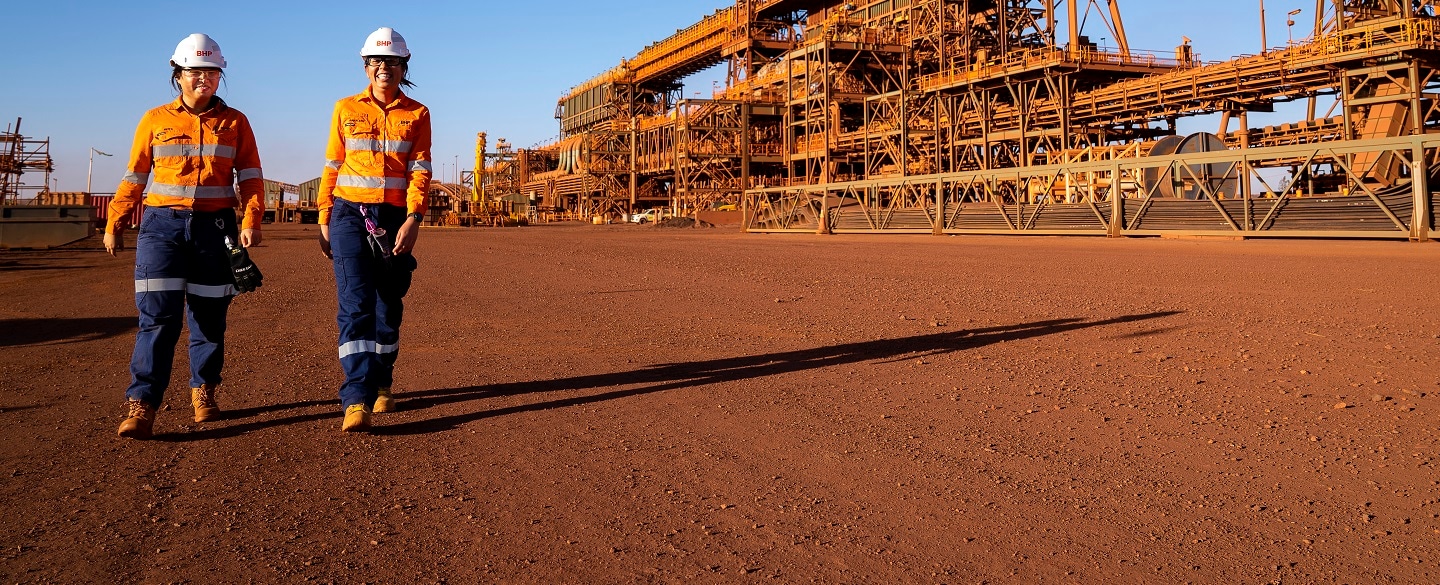
BHP operates an integrated value chain from exploration, production, and logistics. They mainly center on Diversified portfolio, Operational integration, and technology-led efficiency. BHP is known within the industry for having various pipelines across iron ore(~263 million tonnes produced in Pilbara, aiming for >305 Mt annual capacity), metallurgical coal, copper(~2.017 million tonnes, up 8% YoY), nickel, and potash. They own and operate mining, processing, and transporting facilities. Lastly, they also invest in automation and AI to lower costs and predict maintenance costs.
<Key success factors>
BHP’s Maintenance Centre of Excellence deploys AI-driven predictive maintenance across its mining fleet and infrastructure. At Yandi mine, planning accuracy for maintenance jobs rose dramatically, from just 10% accurate in advance to 85%, delivering tangible efficiency improvements.
In WAIO (Western Australia Iron Ore), AI models analyze vast sensor data to diagnose critical issues (e.g., vibration risks), enabling proactive structural interventions and minimizing land disturbance.
The company’s mine fleet is undergoing an autonomy transformation: over 30% of haul trucks are already autonomous, and by the end of fiscal 2027, BHP aims to achieve 85% autonomation, leading to 75% fewer collision incidents than at non-autonomous sites.
In May 2025, BHP established its Industry AI Hub in Singapore, aiming to accelerate AI adoption across the mining and resources sector. In partnership with Enterprise Singapore and AI Singapore (AISG), the hub supports AI-powered solutions spanning procurement, financial forecasting, plant control, and safety analytics. To date, AI-driven plant control at the Escondida mine in Chile has delivered significant resource savings: 3 billion litres of water and 118 GWh of energy since FY22.
<My suggestion for future growth>
BHP should develop an integrated AI-powered resource optimization platform across its global operations and co-invest in multi-user renewable infrastructure projects outside Pilbara, and this could also further position them as a digital and environmental benchmark of global mining firms.
To reduce both capital burden and regulatory risk in the energy transition, BHP should scale its participation in multi-stakeholder renewable infrastructure projects. This approach should be expanded to other high-impact jurisdictions such as South Australia (Olympic Dam), Saskatchewan, Canada (Jansen Potash), and Chile (Escondida Copper). Rather than building proprietary energy networks, BHP should partner with local governments, utilities, and clean-tech firms to co-develop shared green hydrogen pipelines, regional clean energy R&D and training institutes.
Leave a Reply